Author: Technical Editorial Team, HAIDI Laundry Equipment. This guide is organized from industrial laundry equipment project experience and practical equipment configuration discussions.
Executive Summary
To choose a flatwork ironer, begin with the largest flat-linen dimensions, daily piece count, textile types, operating hours, and the condition of linen entering the finishing stage. Select a working width that accommodates the planned feed orientation without assuming that machine width alone determines output. Compare single, double, and three-roller arrangements according to required throughput, available space, heating capacity, operators, and the equipment before and after the ironer. Confirm whether steam, gas, or electric heating is available for the proposed model and site. Review voltage, utilities, feed and discharge space, foundation, ventilation, maintenance access, and any folding equipment connection. Final selection should use model-specific data and a workflow calculation based on actual linen sizes, pieces per day, feeding method, speed, and working schedule.
Key Takeaways
- ✓ Start with the largest sheet or table-linen dimensions and planned feed direction.
- ✓ Calculate demand in pieces by linen type, not only total laundry kilograms.
- ✓ Compare roller quantity with throughput, heating capacity, floor space, and operators.
- ✓ Match steam, gas, or electric heating with actual site utilities and model availability.
- ✓ Check how washed and dried linen reaches the ironer and where finished linen goes next.
- ✓ Allow room for feeding, discharge, folding, service, ventilation, and safe operator movement.
- ✓ Request written confirmation of width, rollers, utilities, speed, and installation requirements.
Definition Box
| Flatwork Ironer | A laundry finishing machine used to dry, press, or smooth flat textiles such as sheets, duvet covers, pillowcases, and table linen, depending on process conditions. |
| Roller Ironer | A general term for an ironer that moves linen through one or more rollers and a heated finishing path. |
| Chest Ironer | An ironer design in which linen contacts a heated chest surface while a padded roller supports movement and pressure. |
| Heated Roller | A roller-based configuration in which heat is applied through the roller assembly; design and heating method vary by machine. |
Who Is This Guide For?
- Hotel Laundry: teams planning sheet, duvet-cover, pillowcase, banquet-linen, and table-linen finishing.
- Hospital Laundry: buyers organizing flat-textile finishing within a documented healthcare laundry workflow.
- Commercial Laundry Plant: operators balancing high-volume washing, drying, ironing, folding, and dispatch.
- Linen Rental Company: businesses handling repeat sizes, customer batches, quality checks, folding, and packing.
- Distributor: equipment partners gathering project data before recommending width, rollers, heating, and layout.
Table of Contents
What Is a Flatwork Ironer?
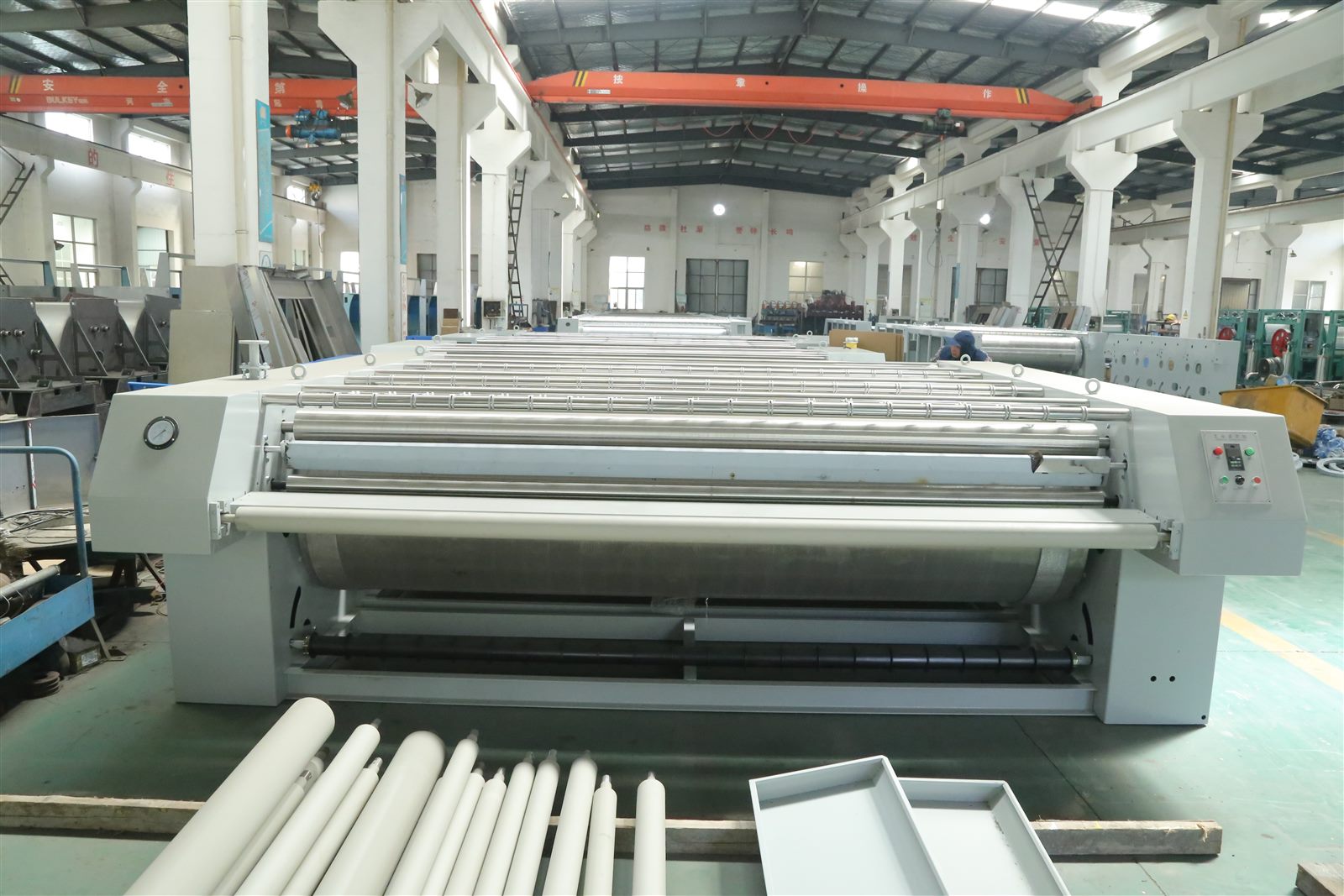
A flatwork ironer is a laundry ironing machine for large, flat textiles. Linen passes through a heated roller or chest system, where heat, pressure, contact time, and movement support finishing. Required incoming moisture depends on machine design, textile, heating, and workflow.
An industrial flatwork ironer follows washing and moisture reduction. A Tumble Dryer may support preparation, while a Washer Extractor influences incoming moisture. Finished linen moves to inspection, folding, packing, or clean storage.
Working width, roller diameter, roller quantity, heating, and speed describe different machine aspects; they are not interchangeable output measures. Review the current Flatwork Ironer specifications after defining project inputs.
Applications
Hotel laundries iron sheets, duvet covers, pillowcases, tablecloths, and banquet linen. Planning should reflect peaks, linen sizes, and finishing hours. The Hotel Laundry Solution shows the complete workflow.
Healthcare laundries may process flat textiles under documented procedures. Equipment must fit separation, washing, preparation, finishing, and clean storage; it does not replace facility hygiene controls. See the Hospital Laundry Solution.
Commercial plants and linen rental companies manage multiple customers, sizes, and schedules. Ironing must align with washing, quality checks, folding, and packing. The Commercial Laundry Solution explains that sequence.
Working Width Selection
Select working width from the widest linen dimension in its planned feed orientation. Measure actual items and confirm whether operators feed them lengthwise or crosswise. Ironing, feeding, and folding stages should use compatible orientation.
Published HAIDI tables include 2800, 3000, and 3300 mm options, but not every width combines with every roller or heating method. For a 3000mm roller ironer, compare sheet width, heating, rollers, output, and layout with the specific model.
Roller Quantity: Single, Double, or Three Roller
Roller quantity affects heated contact, machine length, utility demand, and output potential, but does not define throughput alone. Single roller models may suit lower piece counts; double and three roller options can support more output when heating, feeding, and handling keep pace.
More rollers require enough heating, floor length, service access, operators, and downstream folding. Compare textile condition and working hours across the whole line.
Heating Method: Steam vs Gas vs Electric
Select heating from utilities available at the site and configurations offered for the relevant width and roller count. The published product tables include steam-heated YPA, gas-heated RPA, and electric-heated DYP models. Availability and requirements must be confirmed for the proposed model.
Compare installation, simultaneous utility demand, maintenance, ventilation, and operating hours. Request connection data for the exact model.
Capacity Planning
Plan capacity as pieces by linen type and size, not only kilograms. Record daily and peak quantities, finishing hours, operators, feeding method, incoming moisture, required finish, and folding.
Divide pieces by available hours for a preliminary target, but linear speed does not equal completed pieces per hour. Linen length, feed gaps, operators, rollers, heating, and interruptions affect output. Ask the supplier to review the worksheet.
Machine Facts
The following facts separate current published HAIDI data from project-dependent values. They are not universal specifications for every flatwork ironer.
Installation Requirements
Measure delivery access, room dimensions, floor conditions, and machine position. Reserve infeed space, discharge or folding space, and maintenance clearance. Check multi-roller line length early.
Confirm electrical supply, heating connections, ventilation, foundation, and service access from model documents. Review carts, feeders, folders, and storage. Qualified local professionals should assess relevant site work.
Flatwork Ironer Buying Checklist
Decision Matrix
Common Buying Mistakes
- Choosing by purchase price alone. Compare width, rollers, heating, controls, scope, and workflow fit.
- Using laundry kilograms as the only capacity input. Flatwork planning also needs pieces, sizes, and categories.
- Ignoring feed orientation. Linen dimensions must be compared with how items enter the machine.
- Assuming more rollers automatically solve output. Heating, feeding, folding, labor, and utilities also limit production.
- Selecting heating before checking site utilities. Confirm steam, gas, electricity, ventilation, and total demand.
- Using published speed as finished pieces per hour. Item length, gaps, operators, and interruptions affect output.
- Forgetting feed and discharge space. Machine dimensions do not represent the complete operating footprint.
- Ignoring the folding stage. Finished linen can accumulate if downstream handling cannot receive ironer output.
- Requesting a quotation without linen data. Missing sizes, pieces, moisture, utilities, and room details creates assumptions.
Quick Answers
Question: How do I choose a flatwork ironer?
Answer: Match linen sizes, daily pieces, working hours, incoming moisture, width, rollers, heating, utilities, operators, floor space, and folding workflow with model-specific data.
Question: How should working width be selected?
Answer: Measure the widest item in its planned feed orientation, then confirm usable width and compatibility with feeding and folding equipment.
Question: Is a three roller ironer always required for high volume?
Answer: No. Required rollers depend on the piece worksheet, heating, speed, incoming condition, operators, available space, and downstream capacity.
Question: Which heating method should I choose?
Answer: Compare steam, gas, and electric configurations against actual site utilities, model availability, installation work, operating schedule, and local professional review.
Question: What linen can a flatwork ironer process?
Answer: Common applications include sheets, duvet covers, pillowcases, tablecloths, and similar flat textiles, subject to model and textile confirmation.
Question: Can speed be converted directly into pieces per hour?
Answer: No. Linen length, feed gaps, operators, rollers, heating, incoming moisture, and interruptions influence completed-piece output.
Question: What room information is needed?
Answer: Provide room dimensions, doors, access route, floor, feed and discharge areas, utility locations, ventilation, and service clearance.
Question: What should I send for a quotation?
Answer: Send country, voltage, heating, linen types and sizes, daily pieces, working hours, room dimensions, utilities, and required folding arrangement.
Frequently Asked Questions
What is the difference between a flatwork ironer and a roller ironer?
Flatwork ironer describes the machine's role in finishing flat linen. Roller ironer describes its roller-based mechanism. The terms may refer to overlapping equipment, but buyers should still compare heating design, width, roller dimensions, roller quantity, speed, controls, and process requirements.
What is a chest ironer?
A chest ironer moves linen through a heated chest and roller contact system. Its heat-transfer path differs from a heated-roller design. The appropriate architecture depends on textile, output, utilities, finish requirements, maintenance planning, and the specific machines being compared.
Is 3000 mm working width suitable for hotel sheets?
It can be considered when measured sheet dimensions and feed orientation fit the usable range of the selected model. Confirm the widest linen, edge alignment, operator method, ironer specification, and folding compatibility rather than choosing from the 3000 mm label alone.
How many rollers does a hotel laundry need?
There is no fixed answer by property type. Use daily pieces, sizes, occupancy peaks, available finishing hours, incoming moisture, heating supply, operators, and folding capacity. A smaller hotel may consider one roller, while higher demand may justify additional rollers after calculation.
How is flatwork ironer capacity calculated?
Prepare pieces per day by linen type and size, then divide demand across available hours. Review published speed with item length, feed gaps, operators, heating, incoming moisture, roller quantity, interruptions, and downstream handling. Ask the supplier to verify the worksheet.
Can wet linen go directly into a flatwork ironer?
The required incoming condition depends on machine design, textile, heating, speed, and process plan. Do not assume one moisture condition applies to every ironer. Confirm preparation requirements for the proposed model and coordinate washer extraction or partial drying accordingly.
What utilities are required for a flatwork ironer?
Requirements can include electrical supply and steam, gas, or electric heating according to configuration, plus ventilation or exhaust where applicable. Confirm voltage, frequency, phase, heating conditions, simultaneous demand, and connection details for the exact model.
What installation space should be reserved?
Reserve the machine footprint plus delivery access, linen feed area, discharge or folding area, operator movement, utility connections, ventilation, and maintenance clearance. Multi-roller equipment may need substantial line length. Use model drawings before approving the room layout.
Conclusion
Choose a flatwork ironer by connecting measured linen data with the entire finishing workflow. Confirm item sizes, feed direction, pieces per day, working hours, incoming moisture, required finish, operators, folding, and storage. Then compare working width, roller quantity, heating, published speed, utility demand, and machine dimensions.
Use the Buying Guide Hub to compare related equipment guides, including the Industrial Washer Extractor Buying Guide and Industrial Tumble Dryer Buying Guide. For model matching, submit the checklist information through the Contact page.