Author: Technical Editorial Team, HAIDI Laundry Equipment. This guide is organized from industrial laundry equipment project experience and practical equipment configuration discussions.
Executive Summary
To choose an industrial tumble dryer, first measure the dry weight and textile mix that must be dried each day. Separate towels, uniforms, workwear, sheets, and other loads because their moisture retention and drying behavior differ. Match the dryer with washer extractor output, remaining moisture after extraction, operating hours, and realistic batches. Then compare steam, gas, and electric heating against utilities actually available at the site. Confirm voltage, frequency, ventilation, exhaust routing, make-up air, room dimensions, delivery access, and maintenance clearance before model selection. Review controls according to the temperature, time, drum action, and operator settings needed by the laundry. Industrial dryer capacity should be evaluated as part of the entire workflow, not as an isolated machine rating. Ask the supplier to confirm the proposed configuration from written project information and model-specific technical data. This sequence keeps selection tied to measurable operating needs and actual site constraints.
Key Takeaways
- ✓ Calculate dryer demand from textile mix, dry weight, remaining moisture, and operating hours.
- ✓ Match dryer throughput with washer extractor output and downstream handling.
- ✓ Compare steam, gas, and electric heating using actual site utilities.
- ✓ Confirm exhaust routing, ventilation, and make-up air before ordering.
- ✓ Check country, voltage, frequency, access route, room size, and service clearance.
- ✓ Select controls that operators can use consistently for the required textile programs.
- ✓ Compare quotations on the same capacity, heating, control, and installation scope.
Definition Box
| Industrial Tumble Dryer | A heavy-duty laundry machine that circulates heated air through rotating textiles to reduce moisture after washing and extraction. |
| Commercial Tumble Dryer | A professional dryer used in revenue-generating or institutional laundry operations; the term often overlaps with industrial tumble dryer. |
| Steam Dryer | A dryer whose heating system uses an available steam supply through a compatible heat-exchange arrangement. |
| Gas Dryer | A dryer configured for an applicable gas heating system, subject to model availability, fuel conditions, exhaust design, and local requirements. |
| Electric Dryer | A dryer using electrical heating elements where model configuration and site electrical capacity support the required load. |
Table of Contents
What Is an Industrial Tumble Dryer?
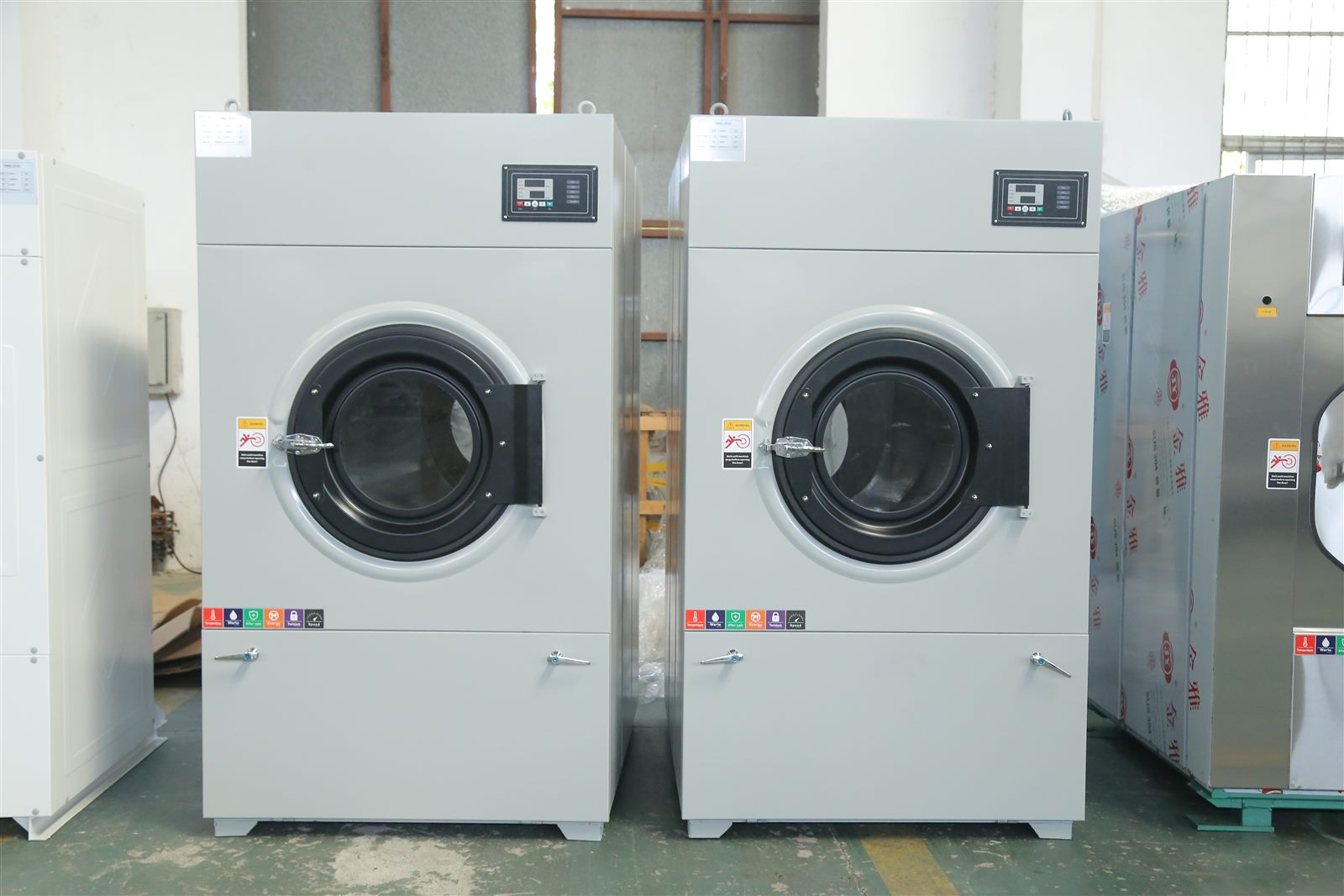
An industrial tumble dryer uses a rotating drum and heated airflow to reduce textile moisture after washing and extraction. Drum movement redistributes the load while warm air passes through it and moist air leaves through the exhaust path. Operation depends on the machine, heating configuration, textile, load, and program.
A commercial laundry dryer commonly follows a Washer Extractor. Wetter textiles require more drying work, so dryer selection must account for extraction rather than nominal load capacity alone.
Towels, uniforms, workwear, and robes often rely on tumble drying. Sheets and table linen may move toward a Flatwork Ironer, while towels usually proceed to folding or storage. Review the Tumble Dryer range after defining this workflow.
Typical Applications
Hotels dry towels, robes, mats, uniforms, and other textiles outside the flatwork line. A hotel tumble dryer should reflect occupancy, peak towel demand, shifts, washer output, and heating source. The Hotel Laundry Solution shows the full workflow.
A hospital tumble dryer must fit documented textile separation, washing, extraction, finishing, and storage plans. Equipment selection does not replace facility-level hygiene controls. See the Hospital Laundry Solution for context.
Commercial laundries, textile plants, and uniform laundries may handle several loads and schedules. Priorities include repeatable output, heating, airflow, and capacity balance. The Commercial Laundry Solution connects industrial laundry dryer output with washing, finishing, and dispatch.
Dryer Capacity Planning
Industrial dryer capacity begins with daily dry-textile weight. Separate towels, sheets, uniforms, workwear, and mats because they differ in bulk, retained moisture, required dryness, and handling. Record peak days, operating hours, batches, and loading time.
Washer capacity does not automatically equal a suitable dryer load. Textile type, drum volume, extraction result, and operating procedure affect loading. Ask the supplier to match industrial dryer capacity with the washer and textile mix.
If washers release wet loads faster than drying can handle, carts accumulate. Multiple dryers may support load separation; one larger machine may reduce batch count. Compare normal loads, peaks, floor space, utilities, folding, storage, and downtime planning.
Drying Workflow
Sort textiles by material, load type, moisture, drying requirement, and next stage. Mixing items with very different weights or drying behavior makes a consistent endpoint harder to determine.
After extraction, loads follow a clear transfer route and an appropriate program. Airflow, heat, drum movement, and time remove moisture. Unloaded textiles may need cooling, folding, ironing, packing, or storage. Capacity planning should include transfer and handling time.
Routine operation also includes lint management and airflow-path inspection. Cleaning points and intervals depend on machine instructions and use, so the layout should allow practical access.
Steam vs Gas vs Electric Tumble Dryers
Choose heating from available utilities. A steam tumble dryer needs a suitable steam supply and compatible model. A gas tumble dryer requires confirmed model availability, fuel conditions, combustion air, exhaust, and local review. An electric tumble dryer requires sufficient electrical capacity.
Also compare installation, simultaneous demand, maintenance, ventilation, and operating schedule. Request written connection data for the proposed configuration.
Airflow and Ventilation
A dryer needs appropriate incoming air and moist-air exhaust. Make-up air and duct routing should follow model and site requirements. Long routes, restrictive turns, shared ducts, or unsuitable discharge locations need early review.
Request airflow and connection details for the proposed model, including cleaning access. For several dryers, review combined demand and room pressure. Gas heating requires project-specific combustion-air and exhaust review by qualified local professionals.
Control System
Controls should support the laundry's textile programs. Confirm available time, temperature, drum-action, cooling, and alarm settings; who can edit programs; and whether interface language needs review.
A hotel may need repeat programs for towels and uniforms, while a multi-customer laundry may need more flexibility. Request documentation for the selected machine because features differ by model.
Installation Requirements
Measure the room, doors, corridors, unloading route, and machine position. Confirm floor condition, dimensions, loading space, service access, cart movement, and connection clearances before shipment.
Provide electrical and heating details, then plan exhaust, make-up air, ventilation, and inspection access. Suitable local professionals should review site work using model-specific connection information.
Industrial Tumble Dryer Buying Checklist
Decision Matrix
This matrix identifies questions to prioritize. It does not prescribe a model or heating method without project data.
Common Buying Mistakes
- Choosing only by purchase price. Compare capacity, heating, controls, included scope, and project fit.
- Matching dryer size only to washer nameplate capacity. Textile bulk and remaining moisture also affect the load.
- Ignoring extraction performance. Wetter textiles create more work for the dryer.
- Assuming every textile dries the same way. Towels, uniforms, sheets, and workwear need separate planning.
- Selecting a heating source before checking utilities. Confirm steam, gas, electricity, and simultaneous demand first.
- Overlooking airflow and exhaust. Ventilation and duct routing belong in the early layout review.
- Ignoring delivery and maintenance access. Room fit alone does not confirm a workable installation.
- Planning no downstream handling. Folding, finishing, carts, labor, and storage must receive dryer output.
- Requesting a quotation with incomplete data. Missing volume, textile, utility, and space information creates assumptions.
Quick Answers
Question: How do I choose an industrial tumble dryer?
Answer: Match daily dry-textile volume, textile mix, remaining moisture, operating hours, washer output, heating source, airflow, utilities, and installation space with model-specific data.
Question: Which heating source should I choose?
Answer: Compare steam, gas, and electric configurations against actual site availability, capacity, installation requirements, operating schedule, and local professional review.
Question: What information is needed for a quotation?
Answer: Provide country, voltage, frequency, heating source, steam or gas availability, dry laundry volume, textile types, washer capacity, ventilation conditions, and room dimensions.
Frequently Asked Questions
How is industrial dryer capacity selected?
Begin with dry textile weight per day, then divide it by textile category and realistic batch size. Include remaining moisture, operating hours, washer output, loading time, and peak demand. The supplier should verify the final selection using technical data for the proposed dryer.
What is the difference between an industrial and commercial tumble dryer?
The terms often overlap. Both describe professional equipment used beyond domestic laundry. Industrial may suggest heavier or higher-volume operation, while commercial can include hotels and on-premise laundries. Buyers should compare actual capacity, construction, heating, controls, utilities, and duty requirements instead of relying on the label.
Is a steam tumble dryer suitable for every laundry?
No. A compatible steam-heated model and suitable site steam supply are required. Confirm supply conditions, total demand, connections, condensate arrangements, operating schedule, and installation responsibilities before selection. Model availability and exact requirements must be checked for the project.
When should a gas tumble dryer be considered?
Gas may be considered when an applicable fuel supply exists and the proposed dryer supports the required configuration. Fuel conditions, combustion air, exhaust, controls, installation work, and local requirements need project-specific review by the supplier and qualified local professionals.
What should be checked for an electric tumble dryer?
Confirm voltage, frequency, phase, heating power, total available electrical capacity, distribution, protection, and cable planning. Include other laundry equipment that may operate simultaneously. Use model-specific connection data and local electrical review before finalizing the installation.
Why does ventilation matter for a laundry dryer?
The dryer needs suitable incoming air and a planned path for moist exhaust. Room ventilation, make-up air, duct arrangement, discharge location, and access for inspection influence installation. Requirements should be confirmed from the proposed model and reviewed for the actual room.
How should a hotel tumble dryer be planned?
Review towels, robes, uniforms, mats, occupancy peaks, daily dry weight, operating hours, washer output, heating availability, and folding or storage capacity. Different textile groups may require separate batches, so room count alone is not enough to select the dryer.
How should a hospital tumble dryer be planned?
Review facility textile groups, documented handling procedures, laundry volume, washing and extraction output, drying programs, utilities, transfer routes, and clean storage. Dryer selection supports the workflow but does not replace facility hygiene procedures or applicable local requirements.
Conclusion
Choose an industrial tumble dryer by connecting textile data with the complete laundry workflow. Measure daily dry volume, identify load types, estimate realistic batches, and assess moisture after extraction. Match dryer output with washing, folding, finishing, labor, and storage rather than comparing capacity in isolation.
Then confirm heating source, voltage, frequency, steam or gas availability, airflow, exhaust, room access, installation space, and service clearance. Compare quotations on the same stated configuration and request written technical data for the proposed model. Submit these project details through the Contact page when requesting equipment matching.