Author: Technical Editorial Team, HAIDI Laundry Equipment. This guide is organized from industrial laundry equipment project experience and practical equipment configuration discussions.
Executive Summary
To choose an industrial washer extractor, begin with measured daily laundry volume, textile categories, operating hours, and realistic batch sizes. Convert the daily load into an expected number of cycles, then check whether loading, washing, unloading, and downstream drying or finishing can support that schedule. Confirm local voltage, frequency, heating source, water supply, drainage, floor condition, access dimensions, and service space before selecting a model. Review controls according to the number of textile programs operators need, and compare extraction performance as part of the total workflow because remaining moisture affects dryer demand. A commercial washer extractor should not be selected by nominal capacity or purchase price alone. Ask the supplier to confirm configuration against country, utilities, textile type, installation room, daily throughput, and future expansion. Final model selection should be based on documented project conditions and the selected machine's technical data.
Key Takeaways
- ✓ Start with daily laundry volume, textile mix, operating hours, and batch frequency.
- ✓ Match washer output with drying, ironing, folding, labor, and clean-storage capacity.
- ✓ Confirm country, voltage, frequency, water, drainage, and heating source before quotation.
- ✓ Evaluate extraction performance because remaining moisture influences downstream drying.
- ✓ Choose controls that fit actual programs and operator responsibilities.
- ✓ Check door access, floor condition, service clearance, and installation route.
- ✓ Allow for realistic peak demand and future growth without routinely underloading the machine.
Table of Contents
What Is an Industrial Washer Extractor?
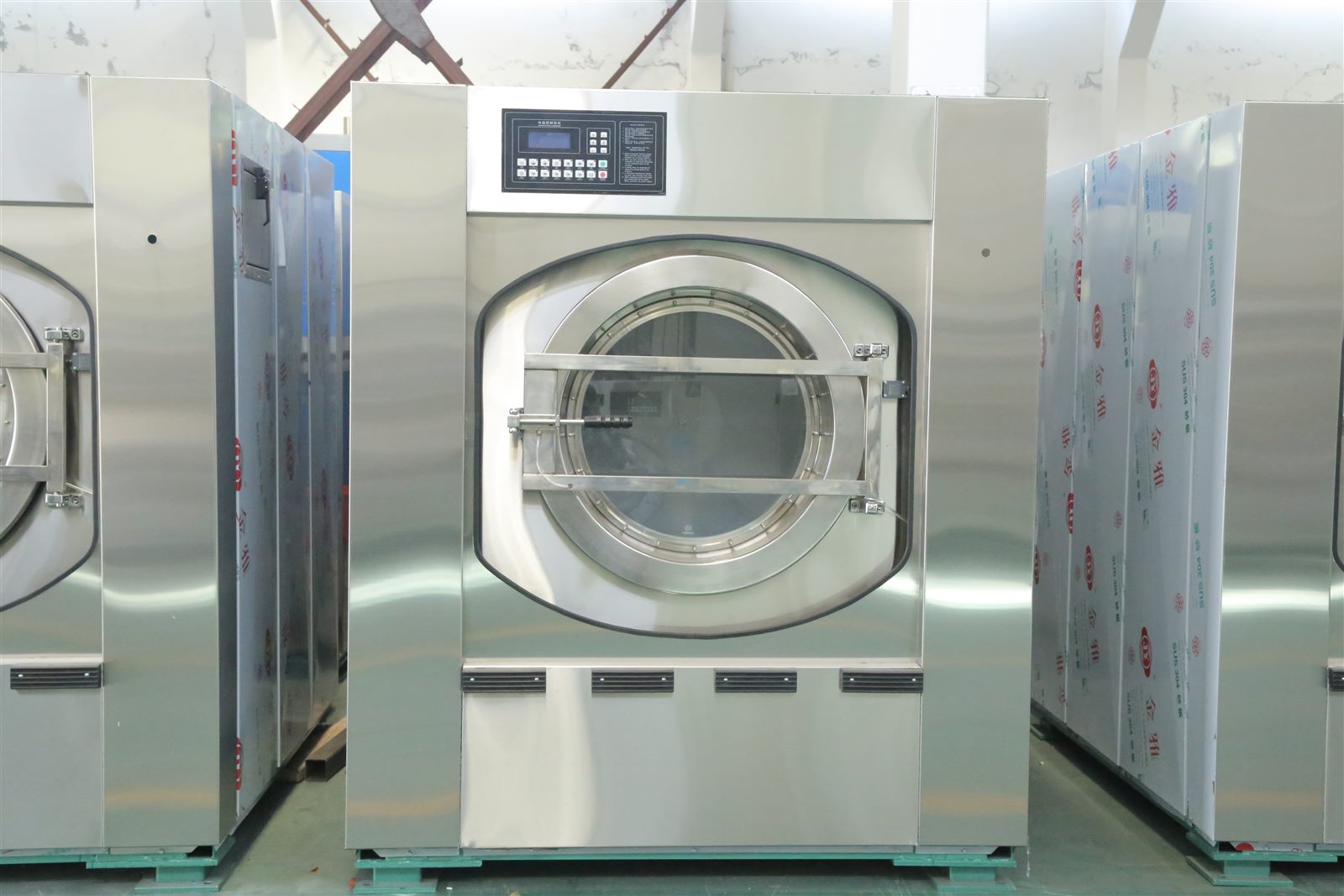
An industrial washer extractor is a laundry machine that performs washing, rinsing, and spin extraction in one drum. During extraction, the drum rotates to remove part of the water retained by the textiles. This reduces the amount of moisture that must be handled by the next stage. Depending on the textile and workflow, washed loads may move to a tumble dryer, a flatwork finishing line, or another handling process.
The term is commonly used for equipment serving professional laundries rather than domestic households. An automatic washer extractor normally uses programmable cycles so the operator can select a process for towels, sheets, uniforms, workwear, or other load categories. The exact controls, extraction settings, heating configuration, and utility requirements depend on the selected model and project.
A washer extractor is one part of an industrial laundry equipment system. Its useful output depends on sorting, loading, water and energy supply, operator routines, unloading, drying, ironing, and folding. Buyers can review the current Washer Extractor range separately after defining the project requirements discussed in this guide.
Applications for Commercial and Institutional Laundries
A commercial washer extractor can serve hotels, hospitals, laundry plants, textile service businesses, factories, and uniform processors. A hotel washer extractor may process sheets, towels, restaurant linen, and uniforms, so flat linen and bulky absorbent items should be separated when estimating batches. The Hotel Laundry Solution maps these loads within the hotel workflow.
A hospital washer extractor should be considered within the facility's textile separation, loading, drying, finishing, and clean-storage process. Machine selection does not establish a hygiene program; operating procedures remain a separate project responsibility. See the Hospital Laundry Solution for the broader workflow.
Commercial plants often handle multiple customers and textile types. Their commercial laundry equipment priorities include batch scheduling, repeatable programs, balanced output, utilities, and expansion. The Commercial Laundry Solution shows the complete plant sequence.
Washer Extractor Capacity Selection Guide
Washer extractor capacity should be selected from actual workload rather than room count alone. Estimate dry textile weight per day and separate it by category because towels, sheets, uniforms, and mixed items differ in bulk, drying, and finishing. Then identify working hours, peak days, and time for sorting and loading.
Divide daily dry-linen volume by the realistic dry load per batch to estimate cycle count. This is not a confirmed production rate: program, water, heating, textile requirements, loading, unloading, and transfer time all matter. Ask the supplier to verify the calculation against the proposed model's data.
One larger machine may reduce batch count, while several smaller units can provide flexibility for separated loads. Avoid assuming every batch reaches theoretical capacity, and avoid a machine so large that normal loads routinely underfill it.
If washing output exceeds dryer or finishing capacity, wet textiles wait. Compare flat-linen output with ironing and folding, and towel or workwear output with drying. Base any expansion allowance on a credible demand plan.
Capacity Comparison Table
This table presents common buying logic, not fixed machine performance. Daily laundry volume must be confirmed for each project, and capacity bands should be matched with actual textile weight, batch composition, operating schedule, and selected model data.
Control System
The control system should match the required wash programs. Identify which textiles need separate cycles, who can edit programs, how operators select them, and whether operating language needs confirmation. Multi-customer laundries may require more flexibility than a facility with a small set of repeat loads.
Confirm configurable settings, displayed information, access levels where required, and available operating guidance. Review controls together with water filling, chemical dosing arrangements, heating, and extraction stages. Request the specification for the proposed configuration because functions vary by machine.
Heating Options
Heating may use steam, electric heating, an external hot-water supply, or another project-specific arrangement. Availability varies by model. Compare existing utilities, local energy conditions, process needs, electrical capacity, and operating schedule before ordering.
Provide relevant steam or hot-water supply conditions, electrical capacity, and site limitations. Consider simultaneous demand from all machines, not one unit in isolation. Qualified local professionals should review utilities, and the supplier should provide connection data for the proposed model.
Voltage and Frequency Considerations
Provide site voltage, frequency, phase, and available electrical capacity. These details must match the machine and any electric heating arrangement. State them clearly in the quotation request.
Consider the total load from washers, dryers, ironers, pumps, and ventilation. A local electrical professional should review distribution, protection, grounding, cable sizing, and applicable site rules using connection information for the proposed equipment.
Installation Requirements
Record room dimensions, entrances, corridor turns, lift limits, floor access, and the route to the final position. Confirm machine dimensions and handling instructions. Allow space for loading, carts, doors, connections, inspection, and maintenance.
Confirm water supply, drainage route and capacity, floor condition, leveling, foundation, and any anchoring requirement against model instructions and local engineering review. Plan chemical arrangements, ventilation, lighting, textile movement, and service access according to facility procedures and applicable local requirements.
Industrial Washer Extractor Buying Checklist
Prepare the following information before asking for model selection or a quotation. Complete inputs help suppliers compare washer extractor capacity and configuration against the real project rather than relying on a general equipment name.
Common Buying Mistakes
- Choosing only by price. Quotes may describe different capacity, controls, heating, scope, or service. Compare the stated configuration.
- Using nominal capacity without a batch plan. Translate daily volume into textile groups, load sizes, operating hours, and cycles.
- Ignoring future expansion. Leave credible utility and service allowance, while avoiding equipment that is oversized for normal loads.
- Ignoring utility requirements. Check voltage, frequency, heating, water, drainage, and supply capacity before confirmation.
- Ignoring extraction speed. Extraction performance and remaining moisture affect dryer workload and workflow balance.
- Comparing the washer in isolation. Dryers, finishing equipment, carts, staff, and storage must receive its output.
- Overlooking access and service clearance. Confirm delivery, positioning, inspection, and maintenance space.
- Providing incomplete inputs. Missing textile, capacity, electrical, heating, and space information creates avoidable assumptions.
Quick Answers
Question: What should I check first when choosing an industrial washer extractor?
Answer: Confirm dry laundry volume per day, textile categories, operating hours, and realistic batch sizes. These inputs define the capacity discussion before controls, heating, and installation are reviewed.
Question: Is a larger washer extractor always more suitable?
Answer: No. The machine should match normal batches and downstream capacity. A larger unit may be difficult to fill consistently, while a smaller unit may require too many cycles during peak demand.
Question: What information is needed for an accurate quotation?
Answer: Provide country, voltage, frequency, heating source, daily dry-linen volume, textile type, operating hours, installation space, water, drainage, and any steam availability.
Frequently Asked Questions
How is washer extractor capacity calculated?
Capacity planning starts with dry textile weight per day, then separates that volume into practical batches by textile type. Buyers should consider operating hours, expected program duration, loading and unloading time, peak demand, and downstream equipment. The supplier should verify the final model against its technical data and the project's actual operating plan.
What is the difference between an industrial washer extractor and an industrial washing machine?
A washer extractor combines washing, rinsing, and spin extraction in one drum. The broader term industrial washing machine may refer to different machine arrangements, including systems where washing and hydro extraction are separate. Buyers should confirm the process, extraction stage, and downstream workflow rather than relying on terminology alone.
Which washer extractor is suitable for a hotel?
A hotel washer extractor should be selected from daily dry-linen volume, occupancy patterns, sheets, towels, restaurant linen, uniforms, working hours, and available utilities. Dryer and flatwork-finishing capacity should be reviewed at the same time. The hotel category alone does not determine a specific machine size.
How should a hospital washer extractor be selected?
Selection should consider daily volume, textile groups, workflow separation, operator procedures, loading route, available utilities, drying, finishing, and clean storage. Machine configuration should support the facility's documented process. Buyers should avoid treating equipment selection as a substitute for facility-level hygiene planning or local requirements.
Should I choose steam or electric heating?
The choice depends on available utilities, local energy conditions, selected model, electrical capacity, operating schedule, and process needs. If steam is available, provide its relevant supply conditions. If electric heating is considered, confirm total site capacity. Ask for model-specific connection information before deciding.
Why does extraction matter when buying a washer extractor?
Extraction reduces moisture retained by textiles after washing. Remaining moisture affects handling and how much work the dryer must perform. Buyers should review extraction together with textile type, machine configuration, dryer capacity, energy planning, and the complete laundry workflow rather than comparing one value without context.
What should be checked before installation?
Check delivery access, room dimensions, floor condition, machine position, water, drainage, voltage, frequency, heating supply, operator space, cart movement, chemical arrangements, and maintenance clearance. Final requirements must follow the selected model's instructions and appropriate local engineering review.
Conclusion
Choosing an industrial washer extractor is a workflow decision. Define the daily dry-linen volume and textile mix, translate the workload into realistic batches, and compare washing output with drying and finishing capacity. Then confirm controls, heating, voltage, frequency, water, drainage, access, floor conditions, and service space for the proposed machine.
A useful washer extractor buying guide cannot replace model-specific technical review. Prepare complete project information, compare quotations on the same configuration basis, and request written confirmation of utility and installation requirements. For equipment matching, submit the checklist details through the Contact page.