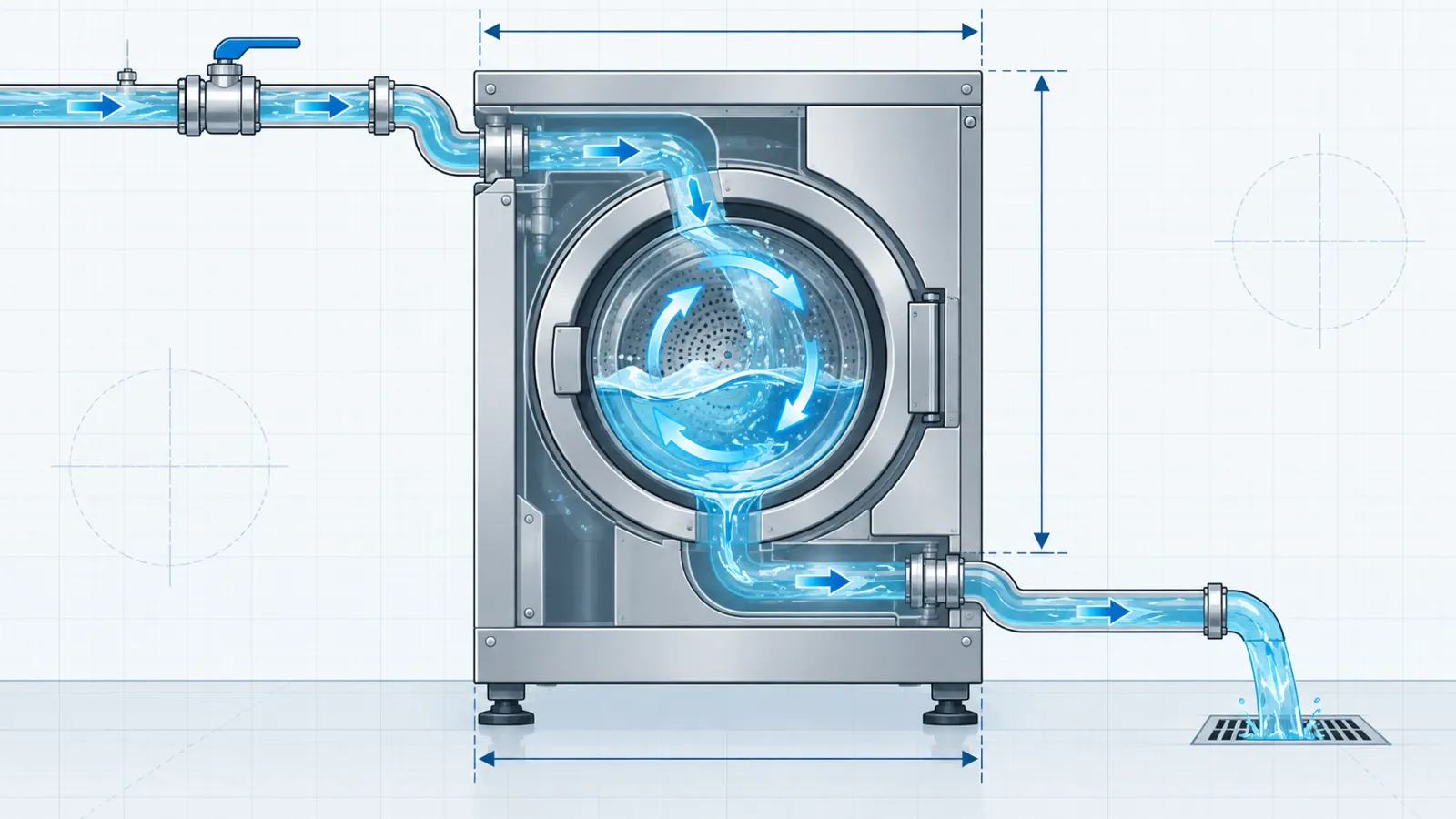
Introduction
Quick Answer: Calculate laundry water consumption from the measured water used by each wash program multiplied by the number of daily cycles, then compare the total with the dry textile weight processed.
Author: Technical Editorial Team, HAIDI Laundry Equipment. This article presents a planning and measurement method for hotel investors, hospital laundry planners, commercial laundry owners, consultants, and equipment distributors.
Water consumption cannot be determined reliably from washer capacity alone. A machine may run different fill levels, rinse counts, load sizes, textile programs, and operating practices. Two laundries using equipment with the same rated capacity can therefore record different daily water totals. A useful calculation keeps program water, actual dry load, cycle count, and textile route visible.
The examples below are illustrations rather than manufacturer specifications or universal benchmarks. Replace every example value with meter readings, selected-program data, actual load records, and local utility information before using the result for investment, engineering, or operating-cost decisions.
Executive Summary
Start with a water meter, machine flow data, or documented program water value. Record the liters used by each complete wash cycle, including fills, washing, rinses, and any program-specific additions. Multiply the measured liters per cycle by the number of cycles run for that program. Add all program totals to obtain daily water consumption, then divide by 1,000 for cubic meters. To compare operations, divide daily liters by the dry kilograms actually processed, but keep textile and program differences visible. Capacity tables should use measured program values rather than generic liters assigned to 15kg, 20kg, 30kg, 50kg, 70kg, 100kg, or 120kg machines. Finally, evaluate water together with wastewater, heating, chemicals, cycle time, extraction, dryer demand, production quality, and local operating requirements.
Key Takeaways
- Measure complete program water use instead of estimating from rated capacity alone.
- Use actual dry batch weight when calculating liters per kilogram.
- Separate programs with different fill and rinse settings.
- Multiply each program's water per cycle by its own daily cycle count.
- Include normal, peak, rewash, cleaning, and non-production water where relevant.
- Convert liters to cubic meters before applying local water and wastewater rates.
- Review water changes together with textile results and the complete laundry workflow.
Table of Contents
Why Water Consumption Matters
Quick Answer: Water use affects incoming utility demand, wastewater volume, water heating, chemical dilution, drainage planning, operating cost, and the capacity of supporting infrastructure.
For a new laundry, estimated daily water demand helps engineers review water supply, storage where applicable, pipe sizing, drainage, and wastewater handling. For an operating laundry, measured water data helps managers explain changes caused by production volume, program selection, rewash, load size, or equipment condition. A single monthly bill cannot show which machine or program created the difference.
Water data also supports equipment comparison, but only when measurements use the same boundary. One quotation may report a specific program, another may provide a maximum fill, and a third may require project confirmation. Buyers should compare complete cycles serving comparable textiles and should ask what stages, fills, rinses, and load assumptions are included.
| Planning Area | Water Data Supports | Buyer Should Confirm |
|---|
| Supply | Daily and peak water demand | Available flow, pressure, storage, and operating schedule |
| Drainage | Expected discharge volume and timing | Drain capacity and local requirements |
| Operation | Program and batch comparison | Textiles, actual load, cycles, and rewash |
| Cost | Water, wastewater, and heating calculations | Local tariffs and billing basis |
Factors Affecting Water Consumption
Quick Answer: The main factors are program design, fill level, rinse count, washer configuration, actual load, textile type, soil condition, rewash, operator practice, water pressure, and maintenance condition.
Wash programs control when water enters and drains. More fills or rinses usually increase the measured total, while different level settings change each fill. Textile absorbency, bulk, and soil condition influence the program selected. Towels, sheets, uniforms, garments, and industrial textiles should not be assumed to use one identical process.
Actual load matters because liters per kilogram uses processed dry weight as the denominator. Running a program with a partial load may leave cycle water similar while increasing the ratio per kilogram. Overloading is not a valid correction because it can affect movement, washing results, extraction, and machine operation. Use a documented usable load appropriate to the textile and program.
| Factor | What Changes | How to Verify |
|---|
| Program | Number and duration of fills and rinses | Program record and complete-cycle meter reading |
| Actual load | Liters per dry kilogram | Weigh the dry batch |
| Textile | Selected process and load behavior | Separate records by textile category |
| Rewash | Additional cycles outside planned production | Record reason and batch weight |
| Maintenance | Unintended fill, valve, or level behavior | Inspection and meter trend review |
The broader relationship between daily volume and batch planning is explained in How to Calculate Industrial Laundry Capacity. Water calculations should use the same volume and batch assumptions as the equipment-capacity plan.
Water Consumption Formula
Quick Answer: Daily water equals the sum of each program's measured liters per cycle multiplied by its daily cycles. Liters per kilogram equals daily liters divided by processed dry kilograms.
| Calculation | Formula | Purpose |
|---|
| Program daily water | Measured liters per cycle × cycles per day | Calculates one program's contribution |
| Total daily water | Sum of all program daily-water totals | Estimates production water per day |
| Daily cubic meters | Total daily liters / 1,000 | Aligns with common utility billing units |
| Water intensity | Total liters / actual dry kg processed | Compares water use against production |
| Monthly planning water | Daily cubic meters × operating days | Supports a period estimate |
Use separate rows for each program. If Program A records 480 liters per cycle and runs 12 times, its illustrative contribution is 5,760 liters. If Program B records a different value, calculate it separately before adding the totals. Do not average programs before considering how many cycles each one runs.
Meter boundaries must be clear. A machine inlet meter measures washer water. A building meter may also include cleaning, boilers, toilets, kitchens, or other users. For equipment analysis, isolate the machine or subtract independently measured non-laundry uses. For site infrastructure, include every relevant water consumer.
Water Usage by Washer Capacity
Quick Answer: Rated washer capacity does not provide a universal water value. For each capacity, record the selected program's measured liters per cycle, actual dry load, and daily cycles.
| Washer Capacity | Program Water Input | Actual Dry Load | Daily Cycles | Daily Water Formula |
|---|
| 15kg | Measure W15 liters/cycle | Record L15 kg | Record B15 | W15 × B15 |
| 20kg | Measure W20 liters/cycle | Record L20 kg | Record B20 | W20 × B20 |
| 30kg | Measure W30 liters/cycle | Record L30 kg | Record B30 | W30 × B30 |
| 50kg | Measure W50 liters/cycle | Record L50 kg | Record B50 | W50 × B50 |
| 70kg | Measure W70 liters/cycle | Record L70 kg | Record B70 | W70 × B70 |
| 100kg | Measure W100 liters/cycle | Record L100 kg | Record B100 | W100 × B100 |
| 120kg | Measure W120 liters/cycle | Record L120 kg | Record B120 | W120 × B120 |
This table intentionally contains variables rather than generic liters. A 50kg washer on one program should not be assigned the same water value as another 50kg washer using different fill logic, rinse settings, textile loads, or controls. Confirm program-specific information for the selected washer extractor.
Hotel Laundry Example
Quick Answer: Separate hotel towels and flat linen by program, multiply measured water per cycle by each program's cycles, then add the totals.
Illustration: A hotel worksheet shows 600 dry kg on a peak day. Twelve 50kg wash batches are planned. Eight towel or mixed-linen cycles measure 500 liters each, and four flat-linen cycles measure 450 liters each. These are hypothetical meter readings used only to demonstrate arithmetic.
| Hotel Program | Illustrative Water/Cycle | Cycles | Calculated Water |
|---|
| Towels and mixed linen | 500 L | 8 | 4,000 L |
| Flat linen | 450 L | 4 | 1,800 L |
| Total | - | 12 | 5,800 L/day |
The illustration gives 9.67 liters per dry kilogram: 5,800 liters divided by 600 kilograms. It is not a hotel benchmark. Replace the example with actual hotel textiles, measured programs, occupancy-driven volume, rewash, and non-production water.
Hospital Laundry Example
Quick Answer: Keep hospital textile categories and approved facility programs separate, then calculate water from measured cycles without making hygiene or processing claims from water volume alone.
Illustration: A facility planning worksheet contains 900 dry kg divided into two documented processing groups. Group A runs ten 50kg cycles measured at 540 liters each. Group B runs eight 50kg cycles measured at 620 liters each. The values illustrate formula use and do not define a hospital standard or required process.
| Facility Program | Illustrative Water/Cycle | Cycles | Calculated Water |
|---|
| Documented group A | 540 L | 10 | 5,400 L |
| Documented group B | 620 L | 8 | 4,960 L |
| Total | - | 18 | 10,360 L/day |
The result is 11.51 liters per dry kilogram for this illustration. Water volume by itself does not demonstrate cleaning outcome, infection control, compliance, or process suitability. Facility procedures and qualified local review determine the actual programs.
Commercial Laundry Plant Example
Quick Answer: Commercial plants should calculate water by customer or program group because textile mix, batch size, and daily cycles can vary across contracts.
Illustration: A commercial laundry plans 2,400 dry kg. One route uses twenty 70kg batches measured at 680 liters per cycle. Another uses ten 100kg batches measured at 900 liters per cycle. The remaining volume is assumed to be included in those illustrative loads; real operations must reconcile every kilogram and cycle.
| Commercial Route | Illustrative Water/Cycle | Cycles | Calculated Water |
|---|
| 70kg planning route | 680 L | 20 | 13,600 L |
| 100kg planning route | 900 L | 10 | 9,000 L |
| Total | - | 30 | 22,600 L/day |
The illustration equals 9.42 liters per dry kilogram. A real plant should separate customers, programs, rewash, partial loads, and cleaning water. Track both production kilograms and water from the same operating period.
How Water Consumption Influences Operating Cost
Quick Answer: Water affects the purchase of incoming water, wastewater charges, water heating, chemicals, pumping, and supporting infrastructure, but local tariffs and system boundaries determine the actual cost.
Convert daily liters to cubic meters and apply the local water tariff. Then identify whether wastewater is billed by metered supply, measured discharge, a fixed ratio, or another local method. Heated water also carries an energy requirement, which depends on incoming temperature, target temperature, volume, heating system, losses, and utility price. Do not combine these costs without documenting assumptions.
| Cost Component | Reference Calculation | Required Input |
|---|
| Incoming water | Daily m3 × local water rate | Metered volume and tariff |
| Wastewater | Billing volume × local wastewater rate | Local billing method and tariff |
| Water heating | Heated volume × project energy calculation | Temperatures, system, losses, and utility rate |
| Chemical use | Program dosage × cycles or textile load | Documented program and dosage basis |
| Monthly estimate | Daily cost × operating days | Realistic production calendar |
Water reduction should not be evaluated alone. A changed program may affect washing outcome, rewash, cycle time, extraction, and downstream tumble dryer demand. Review the complete process and confirm any program change through appropriate operational controls.
Common Mistakes
Quick Answer: The most common errors are assigning generic water values by capacity, mixing wet and dry weights, ignoring program differences, using partial data, and applying tariffs to the wrong volume.
- Assuming every washer of the same rated capacity uses identical water.
- Using one fill volume instead of measuring the complete cycle.
- Dividing by rated capacity when the actual dry load is smaller.
- Combining programs with different fills and rinses into one average too early.
- Ignoring rewash, cleaning, testing, leakage, or non-production consumption.
- Comparing a machine meter with a whole-building utility bill.
- Applying water rates without checking wastewater and billing rules.
- Reducing water settings without reviewing textile results and process requirements.
Frequently Asked Questions
What is the basic industrial laundry water consumption formula?
Multiply measured liters per complete cycle by daily cycles for each program, add the program totals, and divide by 1,000 for cubic meters. Divide liters by actual processed dry kilograms when a water-intensity ratio is needed.
Can water use be calculated from washer capacity alone?
No. Rated capacity does not define program fills, rinse count, actual load, textile type, or controls. Use program-specific data or a complete-cycle meter reading for the selected equipment and process.
Should laundry water consumption use wet or dry textile weight?
Use actual dry textile weight for a liters-per-kilogram production ratio. Keep incoming wet weight separate and document any other measurement basis clearly.
How should multiple wash programs be calculated?
Calculate each program separately because water per cycle and cycle count may differ. Multiply each program's measured water by its cycles, then add the daily totals.
How can a hotel estimate laundry water demand?
Estimate dry textile volume from occupancy and linen records, divide it into actual wash programs, calculate daily cycles, and apply measured water per cycle. Include peak occupancy and rewash records where relevant.
Does more rinse water guarantee a better result?
Water volume alone does not establish textile results. Programs also involve chemistry, temperature, time, mechanical action, textile condition, and operating requirements. Use approved procedures and qualified review.
How should water cost be calculated?
Convert liters to cubic meters, apply local incoming-water and wastewater billing rules, and separately calculate heating or other process costs using documented project inputs.
What data should be requested from an equipment supplier?
Request program-specific water information, measurement basis, fill and rinse logic where available, rated and usable load guidance, connection requirements, flow conditions, drainage information, and model-specific confirmation.
Conclusion
Quick Answer: Reliable water planning combines complete-cycle measurement, actual dry loads, program-specific cycle counts, production records, local utility conditions, and a clearly defined calculation boundary.
Begin with the textile and capacity plan, then measure water for each program under documented conditions. Multiply by actual cycles, reconcile the result with daily production, and compare meter data over time. Keep normal production, peaks, rewash, cleaning, and whole-site consumption separate enough to explain changes.
Use the Industrial Laundry Knowledge Center for related technical planning resources. Final water, drainage, and equipment requirements should be confirmed from the selected machine, site utilities, local requirements, and the project's operating method.
Request Laundry Equipment Recommendation
Prepare your country, daily dry textile volume, textile categories, wash programs, required capacities, productive hours, utility conditions, room dimensions, and measured or expected water data.
Request Laundry Equipment Recommendation