Introduction
Quick Answer: Calculate steam separately for each washer, dryer, ironer, and other steam user, then combine daily consumption and simultaneous peak demand before adding measured distribution losses.
Author: Technical Editorial Team, HAIDI Laundry Equipment. This guide presents an engineering planning method for laundry investors, project planners, consultants, operators, and equipment distributors.
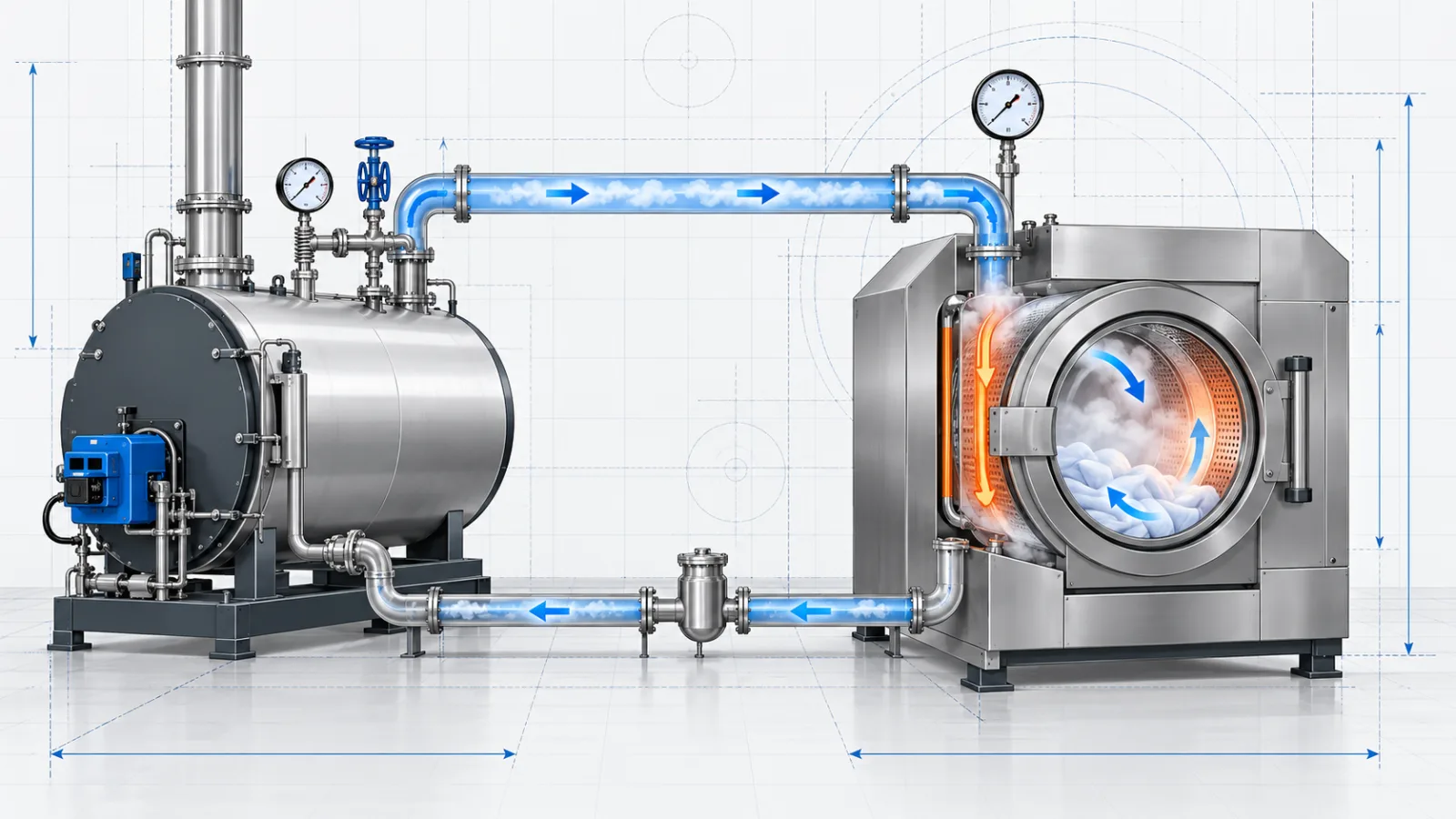
Steam consumption is not determined by laundry kilograms alone. It depends on what steam heats, the starting and target conditions, machine cycles, operating time, steam pressure, steam quality, condensate condition, control behavior, insulation, and the number of machines running together. Daily steam mass and peak boiler output are related but different calculations.
All numerical examples below are illustrations. They do not represent universal machine specifications, boiler settings, hospital requirements, or expected performance. Final calculations require selected-equipment data, steam tables, measured operating conditions, utility design, and review by qualified local professionals.
Executive Summary
Begin by listing every steam user and its operating schedule. For batch equipment, multiply confirmed steam per cycle by daily cycles. For continuous equipment, multiply measured or specified steam per hour by operating hours. When equipment data is unavailable, estimate useful heat from the mass being heated, its heat capacity, and temperature rise, then divide by the usable energy released by steam under the project conditions. Keep boiler efficiency separate: it affects fuel input required to produce steam, not the point-of-use steam mass requested by a machine. Adjust boiler output for documented distribution loss, condensate return, warm-up, and simultaneous demand. Check pressure and steam quality at the equipment connection rather than only at the boiler. Calculate cost from verified steam production cost or from fuel, water, treatment, electricity, and operating inputs using one clearly defined system boundary.
Key Takeaways
- Separate point-of-use steam demand from boiler fuel input.
- Calculate batch machines by cycles and continuous machines by operating hours.
- Use steam properties for the actual pressure, quality, and condensate condition.
- Calculate daily mass and simultaneous peak demand independently.
- Add only documented distribution, warm-up, and operating losses.
- Credit condensate return according to measured return quantity and condition.
- Compare calculations with meters or operating records whenever possible.
- Confirm final utility requirements with equipment and boiler specialists.
Table of Contents
Steam Consumption Formula
Quick Answer: Divide the required useful heat by the usable enthalpy released per kilogram of steam, then adjust for the measured efficiency of the point-of-use heat-transfer process.
For water heating, useful heat can be estimated as water mass multiplied by specific heat capacity and temperature rise. Textile, machine-metal, and process-heating loads may require separate terms when they are material. Use consistent units throughout. Steam properties should come from an appropriate steam table or engineering source for the actual supply and condensate conditions.
| Calculation | Reference Formula | Purpose |
|---|
| Water heating load | Q = water mass × specific heat × temperature rise | Estimates useful heat added to water |
| Point-of-use steam | Steam mass = useful heat / (usable heat per kg steam × process efficiency) | Estimates steam required at equipment |
| Batch daily steam | Steam per cycle × cycles per day | Calculates daily batch-equipment demand |
| Continuous daily steam | Steam per hour × operating hours | Calculates ironer or continuous-process demand |
| Peak steam rate | Sum of steam rates for equipment operating simultaneously | Supports boiler and distribution review |
If a selected machine provides verified steam per cycle or per hour, use that value before a generic heat estimate. The formula is most useful for checking assumptions, filling early planning gaps, or explaining why supply conditions matter. It does not replace equipment connection data.
| Input | Source | Unit Check |
|---|
| Mass being heated | Measured batch or process record | kg |
| Temperature change | Measured or approved process values | degrees C or K difference |
| Steam and condensate enthalpy | Steam table at actual conditions | kJ/kg |
| Process efficiency | Equipment data or measured study | Decimal or percent |
Boiler Efficiency
Quick Answer: Boiler efficiency converts required boiler heat output into fuel input. It should not be used to inflate a machine's point-of-use steam demand.
If the boiler must deliver a defined heat output, divide that output by verified boiler efficiency to estimate fuel energy input. The efficiency basis must be clear because published, seasonal, gross, net, and measured values may not be directly interchangeable. Feedwater temperature, blowdown, combustion, load, maintenance, and heat recovery can affect the operating result.
| Boundary | Calculation | What It Represents |
|---|
| Equipment | Useful process heat / usable steam heat | Steam mass at point of use |
| Distribution | Equipment demand plus documented network loss | Steam leaving the boiler header |
| Boiler | Required boiler heat output / boiler efficiency | Fuel energy input |
| Whole system | Fuel, water, treatment, electricity, labor, and losses | Operating-cost boundary |
Illustration: If a calculation requires 1,000 MJ of boiler heat output and verified operating efficiency is 0.80, illustrative fuel input is 1,250 MJ. This arithmetic does not state an expected boiler efficiency.
Steam Pressure
Quick Answer: Pressure determines saturation temperature and affects available steam properties, control, equipment compatibility, and distribution design; higher pressure does not automatically mean lower steam consumption.
Record pressure at the equipment connection under operating load, not only at the boiler. Pipe sizing, distance, valves, traps, regulators, simultaneous demand, and pressure drop influence delivered conditions. Each washer, tumble dryer, or flatwork ironer must receive steam within its confirmed connection requirements.
| Pressure Check | Question | Why It Matters |
|---|
| Boiler header | What pressure is maintained during operation? | Defines the upstream supply condition |
| Distribution loss | What pressure drop occurs at peak demand? | Tests pipe and network performance |
| Equipment inlet | What pressure reaches each operating machine? | Must match equipment requirements |
| Control and safety | Are regulation and protection suitable? | Requires project-specific engineering review |
Steam Quality
Quick Answer: Steam quality describes the dry-vapor fraction of wet steam. Entrained water reduces usable energy per kilogram and can affect heat transfer and distribution behavior.
For saturated wet steam, quality is represented by a fraction between liquid water and dry saturated vapor. Engineers can calculate mixture enthalpy from saturated-liquid enthalpy plus steam quality multiplied by latent enthalpy. Use actual measurements or justified design assumptions; do not assign a convenient quality value without evidence.
| Condition | Planning Meaning | Check |
|---|
| Dry saturated steam | Reference vapor condition at saturation | Confirm pressure and engineering basis |
| Wet steam | Contains entrained liquid water | Determine or investigate quality |
| Superheated steam | Temperature exceeds saturation at that pressure | Confirm equipment suitability |
| Condensate | Steam has released heat and condensed | Record return temperature and quantity |
Heat Loss
Quick Answer: Include verified losses from warm-up, uninsulated surfaces, distribution, traps, leaks, venting, blowdown, and non-returned condensate, but keep each loss inside the correct calculation boundary.
A daily mass balance can compare boiler steam output with metered or calculated point-of-use consumption. The difference may include distribution loss, measurement error, warm-up, blowdown, unmetered users, or changes in inventory. Investigate the components rather than labeling the entire difference as pipe heat loss.
| Loss Source | Evidence | Possible Action |
|---|
| Pipe radiation | Insulation survey and surface condition | Engineering review of insulation |
| Leaks | Inspection, sound, visible plume, or metering | Repair under approved procedures |
| Trap performance | Trap survey and condensate behavior | Service or replacement review |
| Warm-up | Cold-start steam profile | Separate start-up from steady operation |
| Condensate not returned | Return flow and temperature measurement | Review feasible heat and water recovery |
Steam Requirement by Machine Capacity
Quick Answer: Rated laundry capacity does not define a universal steam value. Record model-specific steam per cycle or calculate the heat load for the selected process.
| Machine Capacity | Steam Input Variable | Daily Operation | Daily Steam Formula |
|---|
| 15kg | Confirm S15 kg steam/cycle | Record B15 cycles | S15 × B15 |
| 20kg | Confirm S20 kg steam/cycle | Record B20 cycles | S20 × B20 |
| 30kg | Confirm S30 kg steam/cycle | Record B30 cycles | S30 × B30 |
| 50kg | Confirm S50 kg steam/cycle | Record B50 cycles | S50 × B50 |
| 70kg | Confirm S70 kg steam/cycle | Record B70 cycles | S70 × B70 |
| 100kg | Confirm S100 kg steam/cycle | Record B100 cycles | S100 × B100 |
| 120kg | Confirm S120 kg steam/cycle | Record B120 cycles | S120 × B120 |
For continuous equipment, replace cycles with operating hours and use confirmed kilograms of steam per hour. Record demand for each program and heating stage separately. The capacity planning method in How to Calculate Industrial Laundry Capacity helps establish the cycles and hours used here.
Hotel Laundry Example
Quick Answer: Add steam for washer cycles, dryer cycles, and flatwork-ironer hours, then check which machines operate together.
Illustration: A hotel worksheet assigns 40kg steam to each of eight washer cycles, 35kg to each of six steam-dryer cycles, and 55kg per hour to four ironer hours. These are invented arithmetic inputs, not equipment specifications.
| Hotel Steam User | Illustrative Rate | Operation | Daily Steam |
|---|
| Washers | 40 kg/cycle | 8 cycles | 320 kg |
| Dryer | 35 kg/cycle | 6 cycles | 210 kg |
| Flatwork ironer | 55 kg/hour | 4 hours | 220 kg |
| Total point-of-use | - | - | 750 kg/day |
The daily total does not size the boiler by itself. Build an hourly schedule to find simultaneous peak demand, then add documented distribution and warm-up requirements.
Hospital Laundry Example
Quick Answer: Calculate steam from the facility's documented programs and equipment schedule without inferring hygiene performance from steam quantity.
Illustration: A facility worksheet uses 45kg per washer cycle for twelve cycles, 38kg per dryer cycle for eight cycles, and 60kg per ironer hour for five hours. Values demonstrate multiplication only and do not define a hospital process.
| Facility Steam User | Illustrative Rate | Operation | Daily Steam |
|---|
| Washers | 45 kg/cycle | 12 cycles | 540 kg |
| Dryer | 38 kg/cycle | 8 cycles | 304 kg |
| Flatwork ironer | 60 kg/hour | 5 hours | 300 kg |
| Total point-of-use | - | - | 1,144 kg/day |
Qualified facility and engineering teams must define the actual programs, temperatures, equipment, redundancy, operating schedule, and local requirements.
Commercial Laundry Example
Quick Answer: Separate customer programs and continuous finishing demand, then calculate daily mass and peak-hour steam for the production schedule.
Illustration: A commercial plant worksheet uses 50kg per washer cycle for twenty cycles, 42kg per dryer cycle for sixteen cycles, and 90kg per ironer hour for eight hours. These values are calculation inputs only.
| Plant Steam User | Illustrative Rate | Operation | Daily Steam |
|---|
| Washers | 50 kg/cycle | 20 cycles | 1,000 kg |
| Dryers | 42 kg/cycle | 16 cycles | 672 kg |
| Flatwork line | 90 kg/hour | 8 hours | 720 kg |
| Total point-of-use | - | - | 2,392 kg/day |
A plant with staggered equipment may have a lower peak than one starting all steam users together. Schedule analysis is therefore necessary even when daily mass is known.
Steam Cost Calculation
Quick Answer: Multiply verified steam mass by a documented cost per kilogram, or calculate cost from fuel, feedwater, treatment, electricity, blowdown, labor, maintenance, and recovery within one boundary.
| Cost Method | Reference Calculation | Required Data |
|---|
| Purchased steam | Metered steam mass × supplier tariff | Billing meter and contract tariff |
| Internal cost per kg | Total defined steam-system cost / net delivered steam | Consistent period and system boundary |
| Fuel input | Required boiler heat output / verified efficiency | Fuel properties, efficiency, and steam conditions |
| Distribution adjustment | Point-of-use demand / (1 - measured loss fraction) | Metered or justified network loss |
| Condensate credit | Measured return water and heat value | Return quantity, temperature, and reuse boundary |
Do not insert a fuel price, boiler efficiency, loss percentage, or condensate credit from an unrelated project. Record currency, taxes, tariff period, fuel basis, and whether capital, labor, and maintenance are included.
Steam Planning Checklist
Quick Answer: A usable steam estimate needs confirmed equipment demand, an operating schedule, point-of-use pressure, distribution information, condensate conditions, and a clearly defined cost boundary.
Begin with a machine schedule rather than a single daily laundry figure. For each steam user, record whether demand is stated per cycle, per hour, or as a maximum connection rate. Note warm-up separately from normal production. A machine may have a brief peak that is important for pipe and boiler review even when its daily steam total is modest.
| Planning Item | Buyer Should Confirm | Evidence to Request |
|---|
| Equipment demand | Steam per cycle, per hour, and maximum rate | Selected-machine utility data |
| Operating schedule | Cycles, hours, starts, and simultaneous users | Production plan or operating record |
| Supply condition | Pressure and steam condition at each inlet | Utility design and pressure review |
| Distribution | Pipe route, insulation, regulation, traps, and loss basis | Mechanical design or site survey |
| Condensate | Return quantity, temperature, pressure, and destination | Return-system design or measurements |
| Boiler system | Output basis, efficiency basis, feedwater, and blowdown | Boiler supplier and operating data |
| Cost boundary | Fuel, water, treatment, electricity, labor, and maintenance | Tariffs, invoices, and accounting scope |
Before procurement, compare all supplier values on the same basis. One quotation may state average cycle use while another states a maximum hourly connection. Converting both into daily steam mass and peak steam rate prevents a misleading comparison. Where existing facilities are available, meter readings and operating logs provide a stronger reference than a generic allowance.
Final boiler, pressure-control, piping, condensate, ventilation, and safety decisions belong in the project utility design. Local professionals should verify applicable rules, site conditions, equipment connection requirements, and expansion allowances before installation.
Common Mistakes
Quick Answer: Common errors mix equipment demand with fuel input, ignore simultaneous peaks, use boiler pressure instead of machine-inlet conditions, and assign generic steam rates by capacity.
- Using daily steam mass as the required boiler hourly rating.
- Applying boiler efficiency to point-of-use steam mass.
- Ignoring steam quality and condensate condition.
- Assuming higher pressure automatically reduces consumption.
- Adding an arbitrary loss percentage without measurements or design evidence.
- Combining warm-up and steady operation without explanation.
- Ignoring condensate return quantity and temperature.
- Comparing supplier values with different programs or boundaries.
Frequently Asked Questions
What is the basic steam consumption formula?
Divide required useful heat by the usable heat released per kilogram of steam and the verified process efficiency. Use steam-table properties for actual supply and condensate conditions.
Can steam consumption be calculated from washer capacity alone?
No. Capacity does not define water volume, temperature rise, program, cycle count, steam pressure, heat transfer, or starting conditions. Use model and process data.
Does boiler efficiency change machine steam demand?
Boiler efficiency changes the fuel input needed to produce steam. It does not directly change a machine's point-of-use steam requirement.
Why does steam pressure matter?
Pressure affects saturation temperature, steam properties, equipment compatibility, controls, and distribution. Confirm pressure at each machine while the system is operating.
What is steam quality?
Steam quality is the dry-vapor mass fraction in wet saturated steam. Entrained water reduces usable energy per kilogram and may affect distribution and heat transfer.
How should pipe heat loss be included?
Use an engineering calculation, metered mass balance, or documented survey. Keep pipe loss separate from blowdown, warm-up, leaks, and unmetered users.
How is peak steam demand calculated?
Create an operating schedule and add the steam rates of equipment expected to run simultaneously, including justified start-up or process peaks.
What information should be prepared for a steam review?
Provide machine list, cycles, hours, schedules, pressure, quality, condensate return, pipe layout, boiler data, feedwater condition, fuel, meters, and measured losses.
Conclusion
Quick Answer: A reliable steam calculation connects useful heat and machine schedules with actual steam properties, distribution conditions, boiler efficiency, condensate return, and a clearly defined cost boundary.
Calculate each user first, then combine daily mass and simultaneous peak demand. Verify assumptions against meters, operating records, selected-equipment data, steam tables, and professional utility design. The related Water Consumption Guide and Industrial Laundry Knowledge Center provide additional planning context.
Request Laundry Equipment Recommendation
Prepare project country, daily textile volume, machine list, cycles, operating hours, steam pressure, boiler information, condensate return, utilities, and installation conditions.
Request Laundry Equipment Recommendation